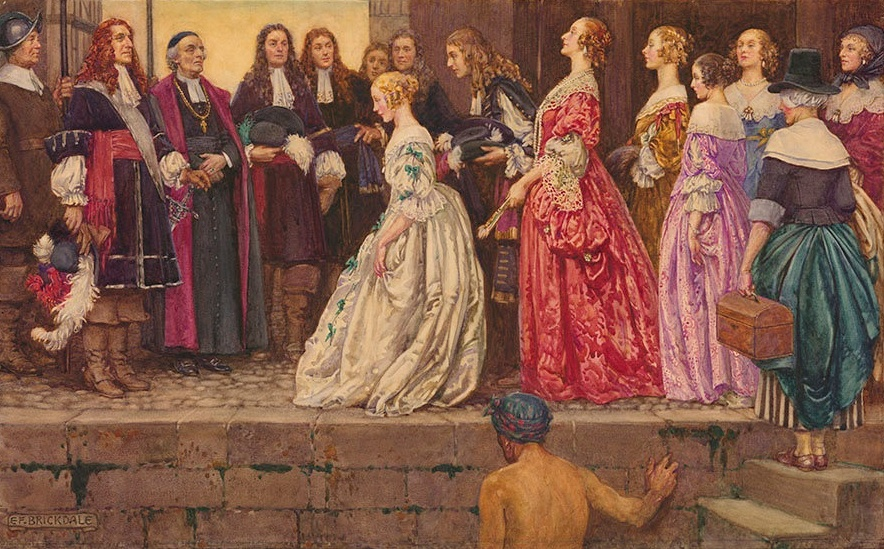
The colony, called Nouvelle-France (New France), was mostly populated by men who were soldiers, fur traders, and priests and this created an imbalance between single men and women. To ensure the success of the colony, France needed to increase the French population and the number of families living there. It was proposed that King Louis XIV give 500 single women a dowry and pay for them to sail to the colony, basically to breed. The king agreed to the plan and between 1663 and 1673 around 800 women and girls became what would eventually be known as the Filles du Roi or King's Daughters. For the most part, the girls were between the ages of 12 and 25 who came from poor families and some were orphans. Girls that came from prominent families that had lost their money were often paired with officers and gentlemen instead of the laborers in the hopes that the nobles would marry them and want to stay in Canada instead of going back to France.
Once a girl was chosen to be a part of the program, she was given a dowry of personal items and some money by the king then sent over on a ship with a group of other Filles du Roi. When they arrived, they stayed with nuns or in other boarding situations until they married. At first, most of them were city girls who didn’t know how to do manual farm labor. Later they began choosing girls from rural areas. Some were sent back for various reasons. About 1000 were chosen and 800 made the journey. It is known that 737 women married and had families. One of those 737 was our 8th great grandmother, Pérette Loriot (spellings of her first and last name vary).
You can read more about the Filles du Roi HERE or watch episode 1 of Canada: The Story of Us which includes the Filled du Roi HERE. A list of all the Filles du Roi and their husbands is HERE.
Pérette was born in a suburb northeast of Paris in about 1654 to Pierre Loriot and Jeanne Bucquet (some sources say her maiden name was Bonnet). In July 1671, when Pérette was 16 or 17 years old, she was chosen as a Filles du Roi and sailed to New France on either Le Prince Maurice or the Saint-Jean-Baptiste (sources differ). By that time there were already 700 children born to the Filles du Roi and their colonist husbands, so her group was one of the last ones to be sent over. On October 21, 1671, nine weeks after she arrived, Pérette married Pierre Buteau at the church of Saint-Anne du Petit-Cap. He was twice her age.
Pierre was born in the Pays de la Loire region of western France to Mathurin Buteau and Marie Rageot around 1635 and emigrated to New France in 1762. In the spring of 1764, he obtained a land grant at the Cote de Beupre, near the St. Lawrence River just north of current day Quebec City. In April of 1670, Pierre made a marriage contract with another Filles du Roi, Jeanne Dufossé, but quickly had it annulled for some reason. (Side note: This was Jeanne’s second annulment. The previous fall, in October 1669, she had signed a marriage contract with Andre Gariteau but it did not last. After her second failed attempt with Pierre, she did finally marry a man named Louis Dore.)
Between 1674 and 1694, Pierre and Pérette had 8 children:
Pierre (1674, our ancestor)
Marie-Madeleine (1677)
Symphorien (1679)
François (1682)
Claire (1685)
Joseph (1688)
Marguerite (1691)
Marie-Françoise (1694)
Their first son, Pierre, was born in 1674 in Sainte-Anne-de-Beaupré but by the time their next child, Marie-Madeleine, was born 3 years later, they had moved across the water to the town of St. Famille on an island in the St. Lawrence River, called Île d'Orléans. Symphorien was also born in St. Famille then the next five other children were born in a different municipality on the island called Saint-François.
The island was still a part of Cote de Beupre, and the 1681 census shows the couple and their three eldest children living there on a farm. It says they had 1 cow and 5 arpents (about the same as 5 acres) of farmland.

There are records of land deals and legal proceedings, both filed by and against Pierre, that seem to have gotten worked out. But in March of 1701, the elder Pierre cut down some trees on land owned by Joseph Bonneau. The minutes of a court proceeding on June 23, say Pierre was conspicuous by his absence. The same thing happened on July 5, 1701 and he was consequently ordered to pay for the trees he had cut down.
On November 21, 1705 when he was about 68, Pierre died of unstated causes. He was buried at Saint-François, Québec.
In 1711, Pierre and Pérette’s son Joseph drowned. He was 22 and unmarried.
Sometime after 1713 after her daughters were married, Pérette moved off the island to the area near Berthier-sur-Mer which is on the other side of the St. Lawrence from where the family started. Her sons Pierrre and Francois both married on the island and moved to the same area. Symphorien, who had always been sickly and never married, had also moved to that area and died there sometime after June 1715.
After a three-week illness, Pérette died on November 13, 1730 when she was about 74. She was buried in Berthier-sur-Mer.
The name Buteau often has various spellings including, Beauto and Butaud. There is a document about Pierre and Pérette written in French that someone has translated into English, but it is not a particularly good translation. It may have just been done on Google. It says
“Our ancestors of France, with the Gaulish spirit, amused themselves by giving men all sorts of names and nicknames. Loiseau, Loisel, Letourneau and Butor are a testimony. Butor, a chaperone neighbor of heron, symbolizes a gross and stupid person. To soften the surname, we invented a diminutive: Butot.”
When it says “a chaperone neighbor of heron” it means that the word “butor” in French means “bittern” in English. A bittern is similar to a heron.
Another site is just as unflattering. It says,
“Most probably an altered form of French Buteux, a nickname for someone who was in the habit of pushing or hitting, also an occupational name for someone whose job was to unload goods or cargo, from Old French bouteor. Alternatively it could be an altered form of Butaud, from the personal name Botwald, composed of the Germanic elements bod(o) ‘messenger’ + waldan ‘ruler’”

No comments:
Post a Comment